SLV Water District and Use of Pesticides on Watershed Lands
By Mary Andersen
The San Lorenzo Valley Water District’s (SLVWD) Integrated Pest Management Policy (IPMP) was created in response to a 2019 ban on glyphosate for district properties. That ban followed community-driven environmental and health risk concerns raised in 2017 and during the 2018 SLVWD board elections. However, the policy’s language and implementation have allowed continued use of other pesticides, such as Garlon 4 (triclopyr), despite similar environmental and human health concerns. The IPMP has not been updated since it was adopted in 2020. District staff are now seeking public input on updating the IPMP, the glyphosate ban, ongoing pesticide use, and how the plan will guide invasive plant and pest management going forward. A public meeting is scheduled for Monday, Dec. 1, at 6:30pm at 12788 Highway 9 in Boulder Creek.
How Garlon 4 Use Persists
The water district’s IPMP states that its goal is to eliminate all pesticide use, referencing the 2019 glyphosate ban and intentions to minimize risk from all pesticides (including herbicides). However, enforcement hinges on two factors: a periodically reviewed “approved pesticides” list and a formal exemption process. Garlon 4 can evade direct prohibition because the 2019 ban specifically targeted glyphosate products, not all similar chemicals. Unless Garlon 4 is explicitly banned or recognized for its carcinogenic or environmental risks, it remains on the approved list, especially if there’s no consensus to remove it during reviews or if exemptions are granted.
Policy Loopholes and Exemptions
Key policy mechanisms contributing to ongoing Garlon 4 use include:
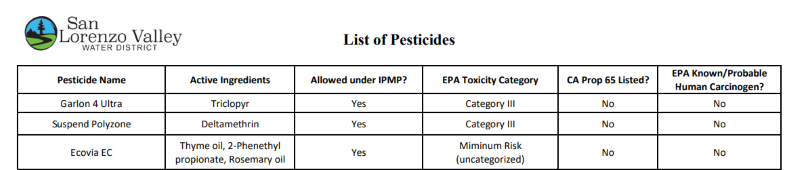
- The policy only bans pesticides in EPA Toxicity Category I and those listed as known or probable carcinogens under California Prop 65, unless specific exemptions are obtained.
- The IPMP maintains a flexible annual list of “allowed” pesticides and relies on the district’s Environmental Committee’s discretion for updates, but lacks transparent public engagement or robust scientific review for potential hazards like triclopyr.
- Exemptions can be granted based on claims of public safety, legal requirements, or lack of alternatives, with minimal community oversight.
Toxicity and Environmental Risks
Garlon 4 (triclopyr) is recognized as highly toxic – particularly to aquatic life – and can persist for years in treated vegetation, soil, and water systems. The product’s environmental risks are significant, including adverse effects on fungi vital for plant nutrition, risks of runoff, and chronic exposure for humans and wildlife. Yet, unless these risks are officially recognized and the product is listed as Category I or II carcinogen, or another regulatory threshold is crossed, it can continue to be applied under local policies designed to be flexible or expedient. Garlon 4 is manufactured by Corteva Agriscience, formerly Dow AgroSciences.
Organizations that have conducted hazard and toxicity studies on Garlon 4 include:
- U.S. Environmental Protection Agency (EPA)
- Massachusetts Department of Agricultural Resources (MDAR)
- Massachusetts Department of Environmental Protection (MassDEP)
- Washington State Department of Transportation (WSDOT)
- Maryland Department of Natural Resources (Maryland DNR)
- Washington State Department of Ecology
- National Pesticide Information Center (NPIC)
- Beyond Pesticides and similar NGOs
- Forest Stewardship Council (FSC) and related certification bodies
- Academic and research institutions
- Forestry and roadside vegetation research groups
These organizations produced or synthesized aquatic‑toxicity findings in fish and amphibian LC50s (a measure of toxicity), embryo malformation data, persistence in water, and broader hazard data for wildlife, plants, and humans that are now cited in discussions of Garlon 4’s risks. Additionally, the Sandhills Conservation and Management Plan prepared for the Land Trust of Santa Cruz County found that “The porous nature of Zayante soils may increase the likelihood that herbicides used in the sandhills will be able to reach groundwater and thus potentially contaminate the public water supply.”
District Rationale
One of the uncomfortable tensions in this story is how an agency that brands itself as an environmental champion ends up relying on a product like Garlon 4, justifying it in terms of cost and convenience. From a budget perspective, a broad‑spectrum pesticide looks efficient: a licensed crew can treat a large area quickly, with relatively cheap material costs compared to years of repeated manual cutting, mulching, or re‑planting with natives. When the district is under pressure from infrastructure repair, storm damage, invasive plants, and ratepayer anger over rising water bills, managers and committee heads can feel boxed into doing more with less, and a powerful chemical tool starts to look like a pragmatic compromise rather than a betrayal of community values.
Also at odds, is the district’s reliance on state grants which can be at risk if environmental processes aren’t able to show the most progress for the least cost. For example, if the cost is $10,000 by hand per acre or $2,000 with pesticides per acre, the choice from a financial and grant acquisition perspective is apparent.
The problem is that this framing counts only the costs that show up on the district’s balance sheet. The time saved by spraying or dabbing pesticides instead of hand‑removing vegetation is easy to quantify. However, the long‑term costs of exposing workers, residents, wildlife, and the watershed to a toxic, persistent pesticide are offloaded onto everyone else and spread out over years. When an agency that touts conservation programs and watershed protection quietly chooses a cheaper but more hazardous pesticide because non‑chemical options are “too expensive,” it reveals a narrow definition of environmental responsibility.
SLV Water District board members defending the use of glyphosate in 2019, referred to its use as “just a little dab, nothing to be afraid of.” That minimalist framing ignores the cumulative effects of tens of thousands of dabs over many years, which justifies attention.
Bryan Largay, hydrologist and current SLVWD board member asserts that in this region integrated pest management plans almost always include herbicides like Garlon 4 once hand‑pulling and other non‑chemical methods are no longer effective or practical. “It is generally infeasible to care for endangered species habitats such as the Santa Cruz Sandhills without sometimes relying on herbicides, just as it would be impossible to provide drinking water without using powerful disinfectants such as chlorine,” he said. Largay maintains that the district applies only minimal pesticide applications. “The foundation of toxicology is that the dose makes the poison,” he said. “When providing drinking water SLV Water uses a safe amount of chlorine. The foundation of integrated pest management is to use safe and very small amounts of herbicides, and only when necessary to, in the case of SLV Water, protect endangered species.” Largay encourages the public to have confidence in the SLVWD staff. He says that allowing endangered species to go extinct on SLVWD properties is not in alignment with the mission of SLVWD or it’s regulatory obligations.
Pesticide Application Log

In a staff recommendation to the SLVWD board of directors, Environmental Programs Manager Chris Klier said, “Herbicide use by the District is infrequent and employed only as a last resort.” However, the recent Pesticide Application Log above describes the Olympia Watershed – Sandhills Restoration Project: From November 2024 through March 2025, licensed applicators treated 0.88 acres within the 63-acre Olympia Watershed Sandhills. Target invasive species were French broom (Genista monspessulana) and black locust (Robinia pseudoacacia). One gallon of Garlon 4 Ultra (triclopyr ester, aquatic-labeled) was applied via basal cut-stump method on freshly cut stumps.
What are the Options?
SLVWD focuses on eradicating invasive species on its watershed lands because unchecked invasives can alter hydrology, degrade water quality, and damage infrastructure, all of which can jeopardize the district’s ability to provide safe, reliable water. Failing to control invasive species can lead to a cascade of problems for the water district, including higher treatment costs.
How do the district and ratepayers balance the high costs of invasive species management with the need to protect the watershed and water supply while minimizing the use of chemicals? While chemical herbicides like Garlon 4 offer a cost-effective solution for large infestations, non-chemical methods like hand pulling are safer but can be labor-intensive. Pesticide use, even in small, targeted doses, introduces risks to non-target organisms and the broader environment, all the while flying in the face of the district’s stated goal “to eliminate the use of pesticides on District property.” This leaves the district caught between fiscal responsibility, public expectations for a healthy environment, and the practical realities of watershed management.
Prior to the district’s adoption of glyphosate, successful eradication efforts included a program of the Mount Hermon Outdoor Science School and community volunteers. From the 2004 Sandhills Management Plan: “Recognizing the negative impacts of these aggressive exotic species on the unique sand parkland community, naturalists and program director Rick Oliver of the Mount Hermon Outdoor Science School (MHOSS) initiated a program to remove broom in the sandhills as part of their weekly curriculum. As one of the elective courses in which they can participate on Wednesday afternoons, 10-30 students work with a MHOSS naturalist to pull broom seedlings as they learn about the sandhills and the threats this aggressive non-native plant poses at the site. Recognizing that the nearly six-acre infestation might present a significant challenge to students, MHOSS and the Mount Hermon Christian Conference Center (MHCCC) partnered with the United States Fish and Wildlife Service (USFWS) through the “Partners for Fish and Wildlife Program” to fund a series of coordinated efforts to remove exotic brooms from the dense parkland on Mount Hermon.” The program logged a 95% success the first year and “those that resprouted the following winter were pulled out of the ground. Left over the summer to dry out, the shrubs were burned on piles in the sandhills habitat or at an off-site location during the winter burn season.”
The MHOSS program featured:
- Uprooting which was found to be quick and effective for small broom plants (roots less than 6 inches deep) to avoid harming endangered beetle larvae in deeper sand.
- Cutting below ground for plants up to 1 inch in diameter – a small bowl is excavated around the base and the root is cut below ground to prevent resprouting.
- Thermal weeding (flaming) used for dense seedlings after adult plants are removed. Propane torches heat seedlings to rupture cell membranes, killing them without chemicals.
The project prioritized areas with the highest ecological value, focusing first on zones with the richest diversity of native Sandhills plants, then moving to degraded and expansion areas. It also specified careful disposal of cut/pulled plants, detailed record-keeping, and monitoring protocols. The program was terminated by the water district which subsequently contracted with various consultants to advise on and administer glyphosate and other pesticides in the Sandhills and watershed lands.
Closing the Loophole
The apparent loophole in the San Lorenzo Valley Water District’s policy, whereby Garlon 4 is still used despite the ethos of pesticide elimination, emerges from narrow definitions and a lack of explicit prohibition for chemical families beyond glyphosate. For meaningful reform, the water district would focus on alternate eradication methods, update their pesticide lists, enforce comprehensive bans, improve transparency on its use of pesticides and watershed activities, and actively engage ratepayers.
The upcoming Special Board Workshop is a chance for residents, staff, and directors to sit in the same room and talk honestly about what “integrated pest management” should mean in a drinking‑water watershed and in neighborhood spaces. Save the date: a public workshop on the District’s Integrated Pest Management Policy will be held from 6:30-8 pm on Monday, Dec. 1, at 12788 Highway 9 in Boulder Creek. Showing up, asking clear questions, and pressing for stronger, more transparent safeguards is one concrete way the community can help move this policy from a paper promise toward authentic watershed protection.
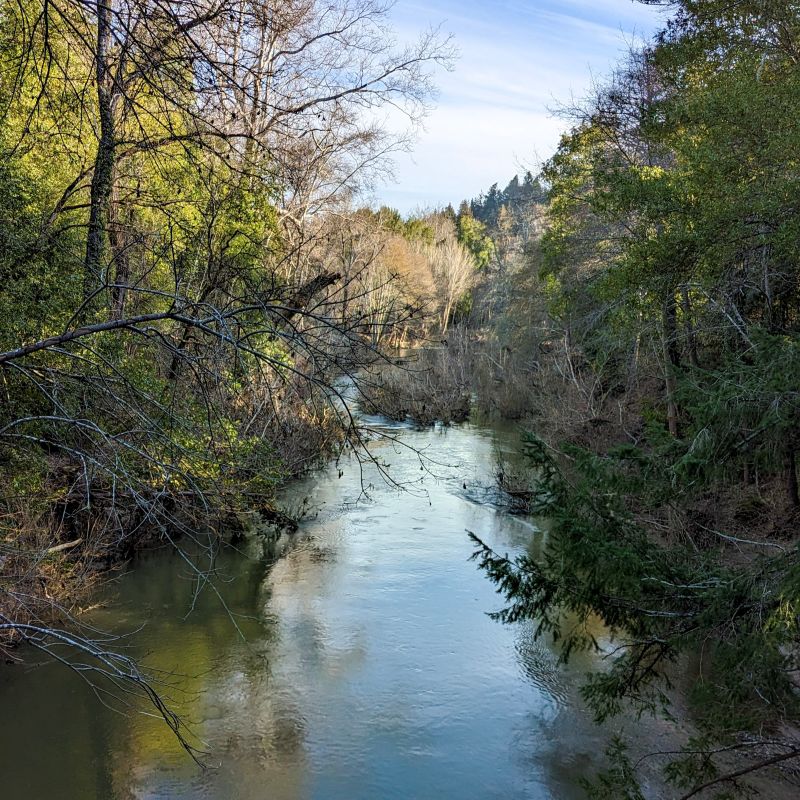
Featured photo by Mary Andersen. Charts courtesy of the San Lorenzo Valley Water District.

Mary Andersen is a journalist, publisher, and editor of the San Lorenzo Valley Post, an independent publication dedicated to the people, politics, environment, and cultures of the Santa Cruz Mountains. mary@slvpost.com